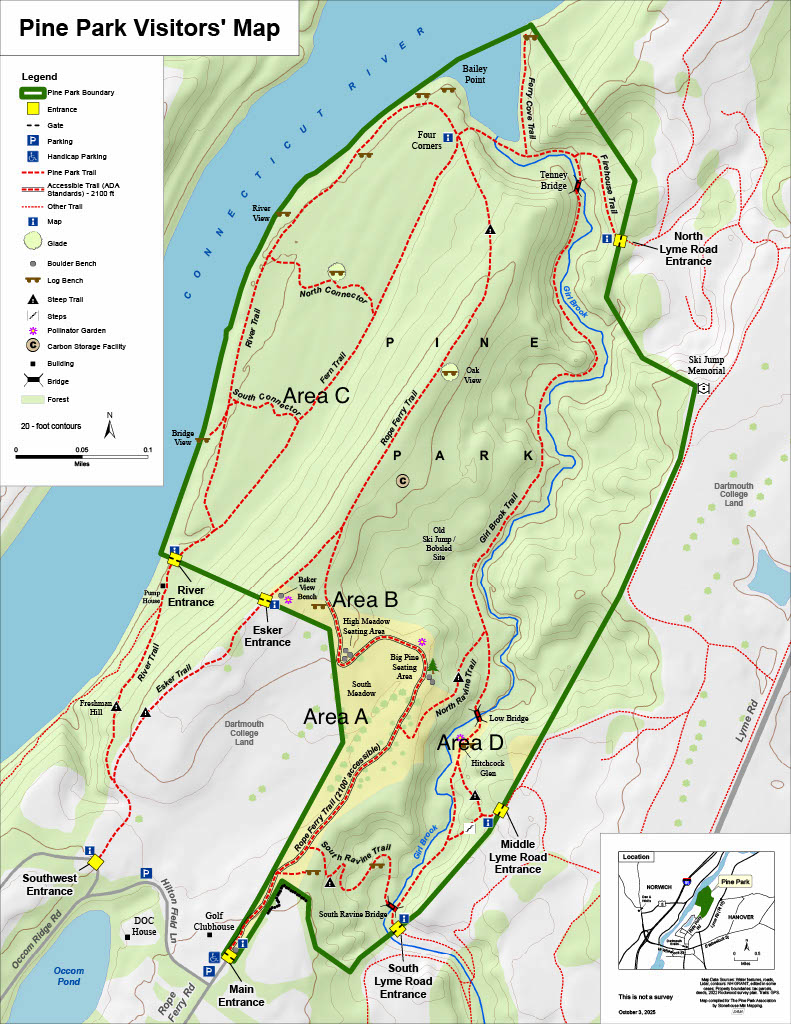
You can choose your preferred tree from the list below, which offers links to descriptions and pictures of the various species. You also can select an area of the park, designated by letters on this map. For example, someone might select a red oak to be planted in the woodland near the Fern Trail labelled as area C. If you choose to indicate area preference, please note this in the message area on the tree selection form.
The following native trees may be donated for planting in designated areas of the Park. Clicking on the tree name takes you to further information about the tree.
- River Birch Betula nigra curling, cinnamon-colored bark, single or multi-stem, glossy leaves, resistant to borers, medium to fast growing
- Red Oak quercus rubra fast-growing, major shade, hardy, acorns, stately
- Scarlet Oak Quercus coccinea brilliant color, fast-growing, acorns, light shade, nonalkaline soil
- Bur Oak Quercus macrocarpa dense shade, hardy, drought tolerant, acorns, long-lived, transplanting difficult
- White Oak Quercus alba fall color, long-lived, acornds, transplanting difficult, can’t tolerate compact soil
- Paper birch Betula papyrifera smooth white bark, yellow fall color, clump or single, acid-loamy soil, NH state tree
- White crabapples Malus ‘Snowdrift’ pink buds & snow white blossoms in early May, fall fruit for birds, medium growing, hardy
- Pink crabapples – local variety
- Red maples acer rurum fall color, tiny red flowers in spring, fast-growing, shade, tolerates variety of soils, deer browse
- Sugar maples Acer saccharum yellow/orange fall color, shade, full or partial sun, needs room to spread, deer browse
- Hornbeam Carpinus moist, well-drained, acidic. Understory tree. Upright variety. “Firespire”
- Larch Larix deciduous conifer with early leaf in spring tall, effective in a group
- Black gum Nyssa sylvatica Stunning fall color, nicely rounded shape, fruit for wildlife, slow growing
- Ironwood Ostrya virginiana tough, understory tree, excellent for naturalizing
- Hackberry Celtis occidentalis broad crown, tolerant of wind, heat, draught, growth pattern like elm. Small fruit for winter birds and attracts some butterflies. Medium to fast-growing.
- Katsura Cercidiphyllum japonicum non-native, pest-free, graceful with high canopy, vulnerable to wind and frost, but not invasive
- Stewartia Stewartia pseudocamellia non-native, small tree with gorgeous flowers, acidic soil.
 The Pine Park Association